Why
Russia Doesn’t Rely on Aircraft Carriers Against the United States | Strategic
Naval Analysis
Introduction
When
comparing the naval power of the United States and Russia, one difference
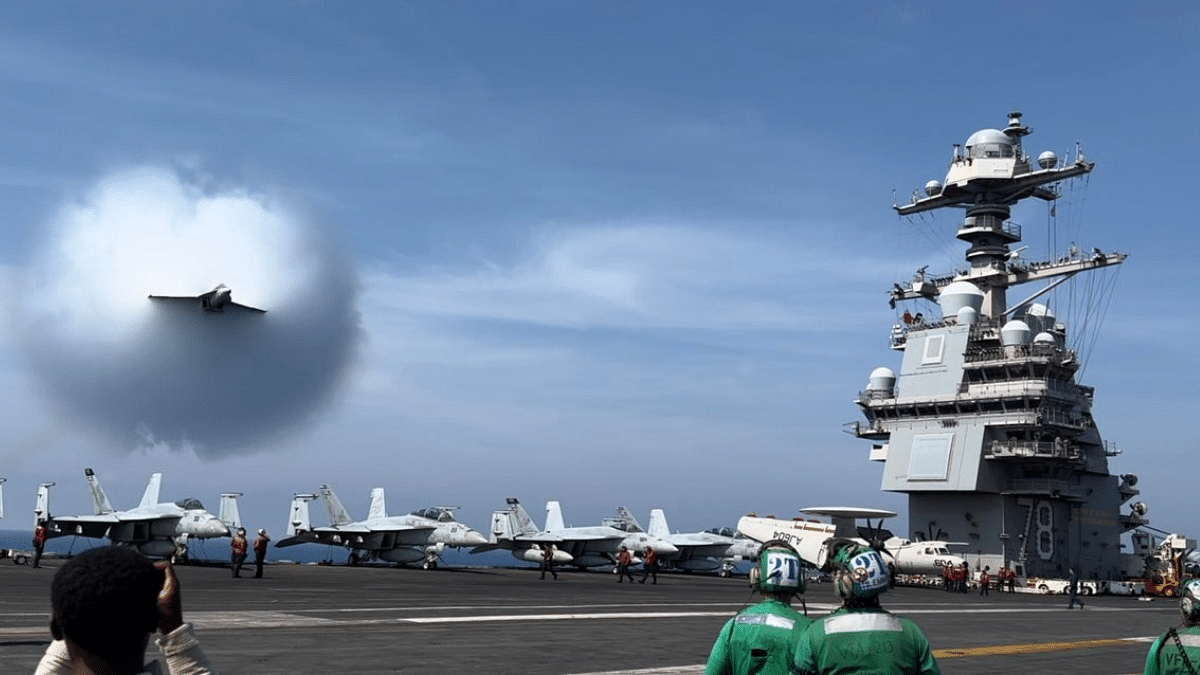
stands out immediately: aircraft carriers. The U.S. Navy operates 11
nuclear-powered aircraft carriers, while Russia has effectively only one
aging carrier, the Admiral Kuznetsov, which has been plagued by
technical failures for years.
This
raises an important strategic question:
Why does Russia not consider aircraft carriers essential when facing the
United States at sea?
The
answer lies in fundamentally different military doctrines, geography, and
modern warfare priorities.
Different Naval Philosophies
The
United States follows a power-projection doctrine. Its aircraft carriers
are floating airbases designed to:
- Launch air strikes anywhere
in the world
- Support overseas military
interventions
- Control sea lanes far from
U.S. territory
Russia,
by contrast, follows a defensive and denial-based doctrine. Its navy is
not designed to dominate oceans globally, but to:
- Protect Russian territory
- Deny enemy forces access to
nearby seas
- Threaten U.S. naval groups
without matching them ship-for-ship
This
difference alone explains why carriers are not central to Russian strategy.
Russia Focuses on “Killing the Carrier,” Not
Copying It
Instead
of building expensive carriers, Russia invests in systems specifically
designed to destroy or neutralize them.
Key Russian Anti-Carrier Capabilities
- Hypersonic missiles (Zircon, Kinzhal)
- Long-range cruise missiles (Kalibr, Oniks)
- Nuclear-powered attack
submarines
- Land-based bomber aircraft armed with anti-ship
weapons
A single
U.S. aircraft carrier can cost $13–15 billion, excluding its escort
fleet. Russia believes it is far more cost-effective to spend a fraction of
that amount on weapons that can threaten or overwhelm carrier defenses.
Geography Works in Russia’s Favor
Unlike
the U.S., Russia does not need carriers to reach distant oceans.
Key Geographic Advantages
- Strong land-based missile
coverage along its coastline
- Strategic access to choke
points like the Arctic, Baltic, and Black Sea
- Ability to deploy aircraft
directly from Russian territory
In
regions such as the Baltic Sea or Black Sea, U.S. aircraft carriers
would operate under constant threat from:
- Coastal missile systems
- Submarines in confined
waters
- Electronic warfare and air
defense networks
For
Russia, land-based air power is safer and more reliable than sea-based
aviation.
Aircraft Carriers Are Vulnerable in Modern Warfare
Aircraft
carriers were once symbols of unstoppable naval dominance. Today, their
survivability is increasingly questioned.
Modern Threats to Carriers
- Hypersonic missiles reduce
reaction time to seconds
- Satellite tracking limits
stealth
- Swarm attacks can overwhelm
air defenses
- Submarines remain difficult
to detect
Russia
sees carriers as high-value, high-risk assets—too expensive to lose and
too visible to hide.
Economic Reality and Sanctions
Building
and maintaining aircraft carriers requires:
- Advanced shipyards
- Reliable logistics chains
- Continuous maintenance and
crew training
Russia’s
economy, especially under long-term sanctions, prioritizes:
- Nuclear deterrence
- Missile technology
- Air defense systems
From
Moscow’s perspective, carriers offer low strategic return compared to
submarines and missiles.
Submarines: Russia’s Preferred Sea Weapon
If
aircraft carriers represent American naval power, submarines represent
Russian naval power.
Russia’s
nuclear submarines:
- Can remain hidden for months
- Carry nuclear and
conventional missiles
- Pose a constant threat to
U.S. naval groups
In a conflict
scenario, Russia would aim to sink or disable carriers early, rather
than compete with them directly.
Psychology of Deterrence
Russia
does not need to control the seas to challenge the U.S. It only needs to:
- Make U.S. naval operations
dangerous
- Raise the cost of
intervention
- Create uncertainty and
hesitation
This
strategy is known as Anti-Access/Area Denial (A2/AD)—and it is where
Russia invests most heavily.
Conclusion
Russia
does not avoid aircraft carriers because it lacks ambition—it avoids them
because it believes they are no longer the smartest tool for modern naval
warfare.
While the
United States uses carriers to project power across the globe, Russia focuses
on:
- Denying access
- Deterring intervention
- Neutralizing enemy strengths
rather than copying them
In a
potential U.S.–Russia naval confrontation, Moscow’s strategy would not be to
match American carriers at sea—but to make them vulnerable, expensive, and
risky to deploy.
In
today’s missile-dominated battlefield, Russia believes the future of naval
power lies below the waves and beyond the horizon—not on massive floating
runways.

Comments
Post a Comment